GBL vs GHB: Key Differences, Pharmacology, Potency & Chemical Properties
Executive Summary
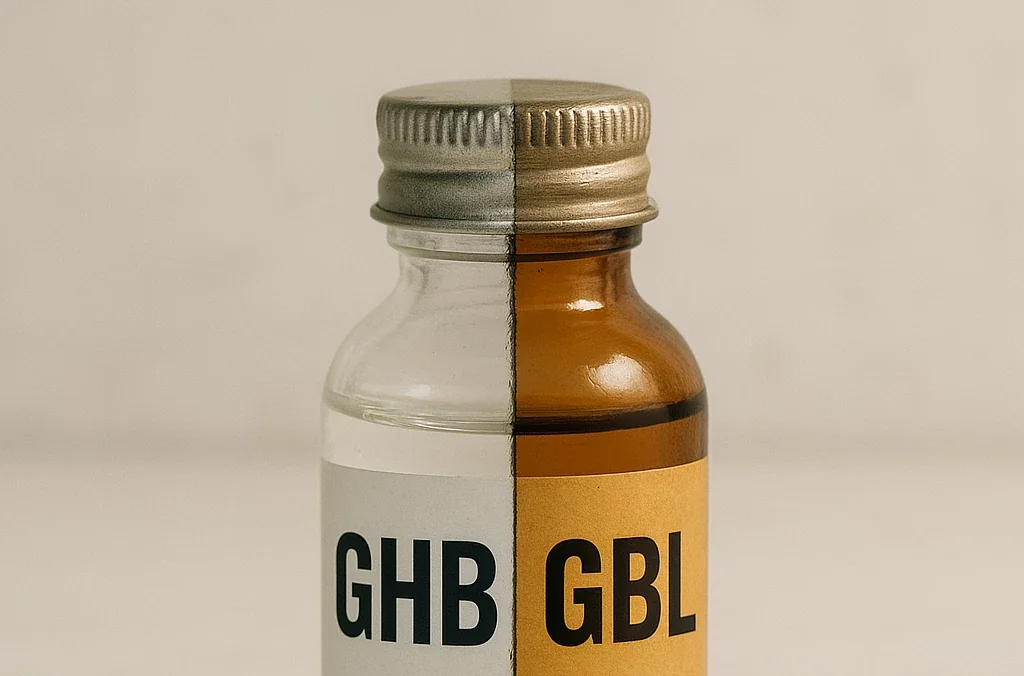
Understanding the scientific and pharmacological distinction between Gamma-Butyrolactone (GBL) and Gamma-Hydroxybutyrate (GHB) is essential for laboratory researchers, chemical analysts, and industrial professionals. While closely related, their molecular structures, metabolic pathways, absorption kinetics, and physical properties diverge substantially.
In biological systems, GBL functions as an uncharged, lipophilic prodrug that undergoes rapid enzymatic hydrolysis into GHB. Because GBL is absorbed significantly faster and exhibits higher molar density per unit volume, its pharmacological onset and potency profile differ markedly from standard aqueous GHB solutions.
Molecular & Chemical Profiles
| Chemical Property | Gamma-Butyrolactone (GBL) | Gamma-Hydroxybutyrate (GHB) |
|---|---|---|
| IUPAC Name | Dihydrofuran-2(3H)-one | Sodium 4-hydroxybutanoate |
| CAS Registry Number | 96-48-0 | 591-89-9 / 502-85-2 |
| Molecular Formula | C₄H₆O₂ | C₄H₇NaO₃ (Na salt) |
| Molecular Weight | 86.09 g/mol | 126.09 g/mol (Na salt) |
| Physical Appearance | Clear, colorless hygroscopic oily liquid | Salty aqueous liquid or white crystalline powder |
| Density | 1.124 g/cm³ (at 25 °C) | ~1.15–1.20 g/cm³ (concentrated solution) |
| Boiling / Melting Point | Boils at 204–205 °C | Melts / decomposes at 146–150 °C |
| Aqueous pH (Neat) | Acidic (pH 4.0 – 5.0) | Neutral / Alkaline (pH 7.5 – 8.5) |
Pharmacokinetics & Metabolic Conversion
The core pharmacokinetic distinction between GBL and GHB centers on biological uptake and rapid enzymatic conversion:
- Lactonase Enzymatic Hydrolysis: When introduced into systemic circulation, GBL is hydrolyzed within 2 to 5 minutes into GHB via the enzyme lactonase (serum paraoxonase, PON1) in the blood and hepatic tissue.
- Lipophilicity & Absorption: GBL is non-ionized and highly lipid-soluble, allowing it to rapidly cross biological membranes and the blood-brain barrier via passive diffusion. In contrast, ionized GHB sodium salts rely on active monocarboxylate transporters (MCTs).
- Onset Kinetics: GBL exhibits a rapid onset of action within 5 to 20 minutes, whereas GHB absorption is slower and food-dependent, taking 15 to 45 minutes.
- Duration of Action: GBL typically sustains physiological activity for 1.5 to 2.5 hours, whereas GHB exhibits a broader curve lasting 2.5 to 4.0 hours.
Potency, Density & Volumetric Calculations
Because GBL is a pure chemical liquid with a density of 1.12 g/mL, 1.0 mL of pure GBL contains 1.12 g of active compound. Upon enzymatic hydrolysis, this produces approximately 1.64 g of GHB sodium salt equivalent.
Standard liquid GHB formulations are diluted aqueous solutions containing between 0.5 g/mL and 0.8 g/mL. As a result, pure GBL is approximately 2.0x to 2.5x more potent per milliliter than typical liquid GHB solutions. Small volumetric measurement discrepancies (e.g. 0.3–0.5 mL) can double the effective dose, requiring strict volumetric syringe precision.
Laboratory Reagent Testing & Verification
Analytical chemists utilize reliable methods to differentiate GBL from GHB:
- pH Testing: GBL yields an acidic reading (pH 4.0–5.0), whereas GHB reads alkaline or neutral (pH 7.5–8.5).
- Ferric Chloride Assay: GHB forms a reddish-brown coordination complex when reacted with $FeCl_3$, whereas GBL shows zero color change until base hydrolysis is performed.
- FTIR & GC-MS: Gas chromatography-mass spectrometry provides definitive molecular identification and confirms assay purity exceeding 99.8%.
Harm Reduction & Safety Protocols
- Never Handle Undiluted GBL: Pure GBL is a powerful polar solvent that causes chemical erosion to mucosal membranes. Heavy aqueous dilution is essential for handling.
- Volumetric Calibration: Always measure with calibrated 1.0 mL syringes or laboratory pipettes. Kitchen spoons or estimations create acute overdose risks.
- Strict Polysubstance Avoidance: Co-ingestion with central nervous system depressants (ethanol, benzodiazepines, ketamine, opioids) causes synergistic GABA-B receptor suppression, profound coma, and respiratory failure.
- Storage Compatibility: Store only in fluorinated HDPE, PTFE, or borosilicate amber glass. GBL dissolves standard polystyrene, polycarbonate, and PVC plastics.
Frequently Asked Questions
How quickly does GBL convert into GHB in the human body? ▾
GBL is converted into GHB within minutes following systemic absorption. The reaction is catalyzed by lactonase enzymes (serum paraoxonase) present in human blood plasma and liver tissue.
Why is GBL considered more potent than GHB by volume? ▾
Pure GBL has a density of 1.12 g/mL and contains 100% active lactone precursor, whereas liquid GHB is an aqueous solution of sodium salt (typically 50% to 70% water). 1 mL of pure GBL yields roughly 1.64 g of GHB sodium salt upon conversion.
How can laboratories distinguish between GBL and GHB? ▾
Laboratories use pH testing (GBL is acidic at pH 4–5, GHB is alkaline at pH 7.5–8.5), infrared spectroscopy (FTIR), gas chromatography-mass spectrometry (GC-MS), or ferric chloride colorimetric assays.
What are the storage requirements for high-purity GBL? ▾
GBL must be stored in fluorinated HDPE containers, PTFE vessels, or airtight borosilicate amber glass bottles. Standard polystyrene or thin PET containers will degrade and dissolve when exposed to pure GBL solvent.
Certified Laboratory Formulations
High-purity chemical reagents tested via GC-MS with verified dispatch across Europe.
Related Educational & Laboratory Guides
Expand your research with peer-reviewed protocols, chemical comparisons, and safety data.
What Is GBL Chemical Used For? Industrial Applications, Chemistry & Laboratory Synthesis
In-depth technical guide to Gamma-Butyrolactone (GBL): lithium-ion battery electrolytes, precision electronics cleaning, polymer stripping, chemical synthesis, and safety.
GHB Effects, Pharmacology & Risks: Evidence-Based Mechanism, Toxicity & Safety Guide
A detailed scientific analysis of Gamma-Hydroxybutyrate (GHB): GABA-B receptor kinetics, dose-dependent pharmacological effects, overdose indicators, and clinical emergency protocols.
Can GBL Melt Plastic? Top 10 Questions on GBL Storage, Bottle Types & Safety
Direct answers to the top 10 questions about GBL plastic compatibility: why GBL dissolves certain bottles, safe plastics (HDPE vs PET), glass storage, leak prevention, and spill cleanup.
Dispatched from France with 100% Guaranteed European Delivery
Every parcel is double vacuum-sealed in generic, tamper-proof packaging. Dispatched daily across 11 European countries with tracked delivery and full reship guarantee.